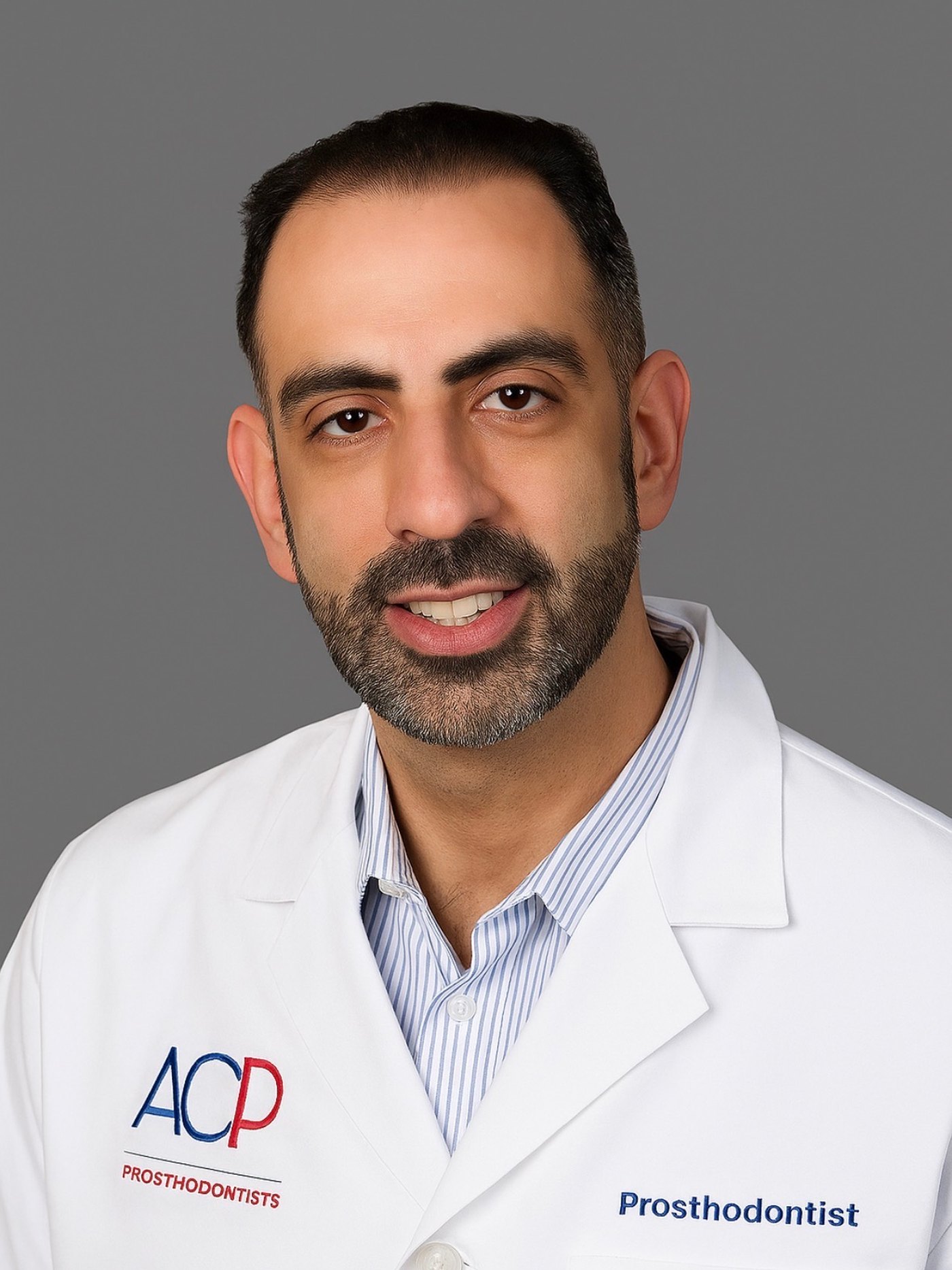
Prosthodontist
Dr. Jonathan Berkowitz, DMD
A surgically trained prosthodontist — the dental specialist who rebuilds teeth that are broken, failing, or missing. He placed hundreds of implants during his residency, and spent ten years as a hospital attending prosthodontist training residents of his own.
Background
Dr. Jonathan Berkowitz grew up in Queens and on Long Island. He earned his Bachelor of Science from the University of Wisconsin–Madison in 2007 and his Doctor of Dental Medicine from the University of Pittsburgh School of Dental Medicine in 2012.
After dental school he completed a general practice residency at the Veterans Administration Hospital in Montrose, New York — a hospital-based program that exposes residents to a far broader and more medically complex range of patients than most new dentists encounter.
He then undertook a three-year prosthodontic residency at the University of Michigan and the Detroit Veterans Administration, one of the most respected specialty programs in the country. It is a surgical program as well as a restorative one, and he placed hundreds of implants over the course of it — not a handful of supervised cases, but the volume that turns a technique into an instinct. In his final year he was appointed Chief Resident and served as an instructor at the University of Michigan Dental School, teaching the discipline to the residents coming up behind him.
He then spent ten years as the attending prosthodontist at the Northport Veterans Administration Medical Center on Long Island, where he trained many residents of his own — a number of whom have said since how much the training mattered to them.
That decade is worth pausing on. A hospital attending sees the cases that arrive without warning and without an easy answer: patients with complex medical histories, extensive tooth loss, failed previous work, and situations a private practice can choose to decline. Ten years of that, while simultaneously teaching residents how to think through it, is a different kind of experience from ten years of routine restorative dentistry.
He now practices alongside his father, Dr. Steven Berkowitz, on West 86th Street.
What prosthodontic training actually covers
Dental school teaches every dentist to fill teeth, make single crowns, and manage routine care. A prosthodontic residency is three additional years spent almost entirely on what happens when that is not enough.
The core of it is occlusion — the study of how the upper and lower teeth meet, how chewing force is distributed, and what happens to restorations when that distribution is wrong. This is the least visible part of dentistry and the most consequential. A crown that fractures every few years, a bridge that keeps debonding, a set of veneers that chip: these are almost never material failures. They are bite failures.
The rest of the training covers implant surgery and implant restoration, full-arch rehabilitation, removable prosthetics, maxillofacial prosthetics for patients who have lost tissue to cancer or trauma, and dental esthetics as it relates to the whole face rather than to individual teeth.
Placing and restoring under one roof
Most dental implant treatment in New York is divided between two practices. An oral surgeon or periodontist places the implant, and a general dentist makes the crown that goes on it. Both may do their part competently, and the result can still be poor — because an implant placed without a clear plan for the tooth that will sit on it is a surgical success and a restorative problem.
Dr. Berkowitz does both. His residency was surgical as well as restorative — hundreds of implants placed during training, and ten years of hospital practice after it. The final tooth is designed before the implant is placed, and the implant is positioned to serve that design. If something needs adjusting later, one person is responsible, and there is no question of which office is at fault.
Specialty Treatment
What Dr. Berkowitz treats
The cases that prosthodontic training exists for.
Dental Implants
A permanent replacement for a missing tooth that looks, feels, and functions like your own — placed and restored under one roof.
Learn more about Dental ImplantsFull-Arch Implants (All-on-4 & All-on-X)
A fixed, non-removable set of teeth supported by four to six implants. For patients facing the loss of an entire upper or lower arch.
Learn more about Full-Arch Implants (All-on-4 & All-on-X)Full Mouth Reconstruction
Rebuilding an entire bite when years of wear, grinding, decay, or old dentistry have caught up with you.
Learn more about Full Mouth ReconstructionFailing Implants & Second Opinions
If an implant, bridge, or denture done elsewhere has failed or never felt right, a prosthodontist can tell you why — and what can be done.
Learn more about Failing Implants & Second OpinionsDentures & Denture Alternatives
Well-made conventional dentures, implant-secured overdentures that do not slip, and honest guidance on which is right for you.
Learn more about Dentures & Denture AlternativesCrowns & Bridges
Porcelain restorations that protect a damaged tooth or replace a missing one, designed to match the teeth beside them.
Learn more about Crowns & BridgesVeneers & Cosmetic Dentistry
Conservative porcelain veneers and smile design from a specialist trained in the esthetics of the whole face, not just the teeth.
Learn more about Veneers & Cosmetic DentistryQuestions
About seeing a specialist
What exactly is a prosthodontist?
A prosthodontist is a dentist who has completed three additional years of full-time, hospital-based residency after dental school, focused entirely on replacing and restoring teeth. Prosthodontics is one of only twelve dental specialties recognized in the United States.
The training covers dental implants, full-arch restoration, crowns and bridges, dentures, and — importantly — occlusion, the study of how teeth meet and how force is distributed across a bite. That last subject is the reason prosthodontists are the specialists called on when restorations keep failing.
Do I need a referral to see Dr. Berkowitz?
No. You are welcome to call the office directly at 212-874-1700 and book a consultation yourself.
Many patients are referred by their general dentist or oral surgeon, and many find us on their own after researching their options. Both are equally welcome.
Does he place implants himself, or only restore them?
Both. Dr. Berkowitz is a surgically trained prosthodontist — he performs the surgical placement himself and makes the final teeth that go on top. He placed hundreds of implants during his residency alone, before ten years of hospital practice on top of that.
In many practices those two stages are split between separate offices, which is where communication breaks down and where patients end up caught between two dentists when something is not right. Having one specialist responsible for the whole case removes that problem.
Does he also do routine dentistry?
Yes. Prosthodontists are fully qualified dentists, and he performs general restorative work as well as specialty treatment.
Many longtime patients continue to see Dr. Steven for their cleanings and checkups, with Dr. Jonathan handling the more complex work when it is needed.
Bring us the case somebody else could not solve.
Second opinions are welcome, referrals are not required, and there is no obligation to have treatment here.
40 West 86th Street, Suite 1C · New York, NY 10024